Gov’t Clarifies The Proposed Privileges And Immunities Act
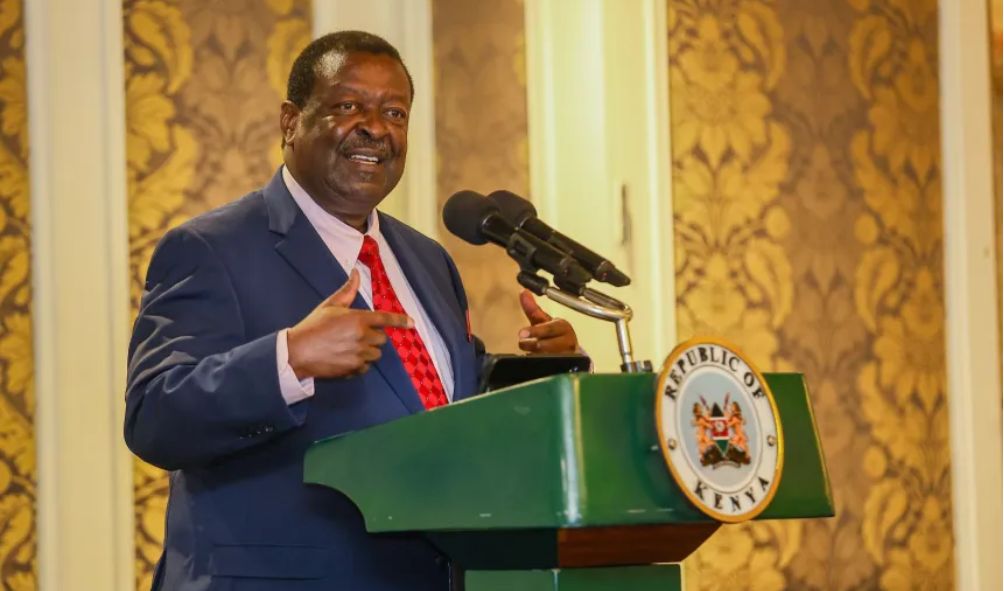
Prime Cabinet Secretary Musalia Mudavadi has provided a full explanation of the government’s planned ammendments to the Privileges and Immunities Act.
This comes at a time when the public is increasingly interested in how the changes will affect foreign embassies, international organisations, and global non-profits functioning in Kenya.
In a news statement dated November 18, 2025, Mudavadi stated that the revisions are part of a larger attempt to modernize and simplify Kenya’s diplomatic and international cooperation framework.
He underlined that this is due to Nairobi’s continued expansion as a worldwide diplomatic hub.
“Nairobi has evolved into a major diplomatic hub, and with that comes the responsibility to manage privileges and immunities in a structured, transparent, and predictable manner,” he said.
Kenya’s capital today has a dense network of foreign embassies, multilateral organizations, and specialized external agencies, ranging from INGOs to international foundations.
Against this backdrop, Mudavadi stated that the government is committed to preserving clear, consistent, and constitutionally regulated mechanisms for bestowing privileges and immunities.
“These amendments are designed to strengthen compliance and improve administrative efficiency, not to undermine any of our treaty obligations,” he stated.
At the heart of the explanation is the distinction between inter-governmental organizations (IGOs) and international non-governmental organizations (INGOs).
Mudavadi emphasized that the proposed revisions have no bearing on the privileges of international organizations such as the United Nations, African Union, World Bank, IMF, COMESA, EAC, or African Development Bank.
“Let me be unequivocal, these amendments do not dilute or alter the rights and privileges of inter-governmental organisations,” he noted.
“Kenya cannot and will not apply domestic legislation in a manner that contradicts its international commitments.”
He stated that these entities are protected by multilateral treaties to which Kenya is a State Party, and that domestic legislation cannot override such responsibilities.
Instead, the changes are largely aimed at international NGOs and other globally recognized groups controlled by Section 11 of the Act.
These groups operate in Kenya under Host Country Agreements, which specify the nature of their collaboration with the government and the rights granted to them.
Following the adoption of a revamped Foreign Policy in December 2024 and the passage of a related Sessional Paper in early 2025, the Ministry began to streamline the negotiation and implementation of these agreements.
According to Mudavadi, the goal is to improve predictability, compliance, and administrative efficiency, especially in administering the exceptional rights granted to certain groups.
A crucial proposed adjustment would establish a cap ensuring that expatriates hired by internationally recognized entities do not exceed one-third of the organization’s overall employment.
ALSO READ:
- Kenya’s David Munyua Heads Back To PDC World Darts Championship
- A Man Dies In Police Custody, Family Says Victim Had Mental Illness
- DP Kindiki Makes A Ksh39 Billion Projects’ Pledge To Meru, Slams Local Leaders
- FKF Issues Way Forward On Kenya Premier League’s New Season
- Court Rules On 8 Utumishi Girls Fire Suspects, Explains Reasons Behind
This, Mudavadi noted, is intended to safeguard job opportunities for Kenyans and reinforce the principle of local capacity building.
“This provision is not punitive,” Mudavadi explained. “It is meant to protect employment opportunities for Kenyans and promote the transfer of skills within these organisations.”
The PCS affirmed that the proposed reforms will strengthen Kenya’s standing as a responsible host to global organisations while ensuring accountability, legal clarity, and national interest remain paramount.
Gov’t Clarifies The Proposed Privileges And Immunities Act