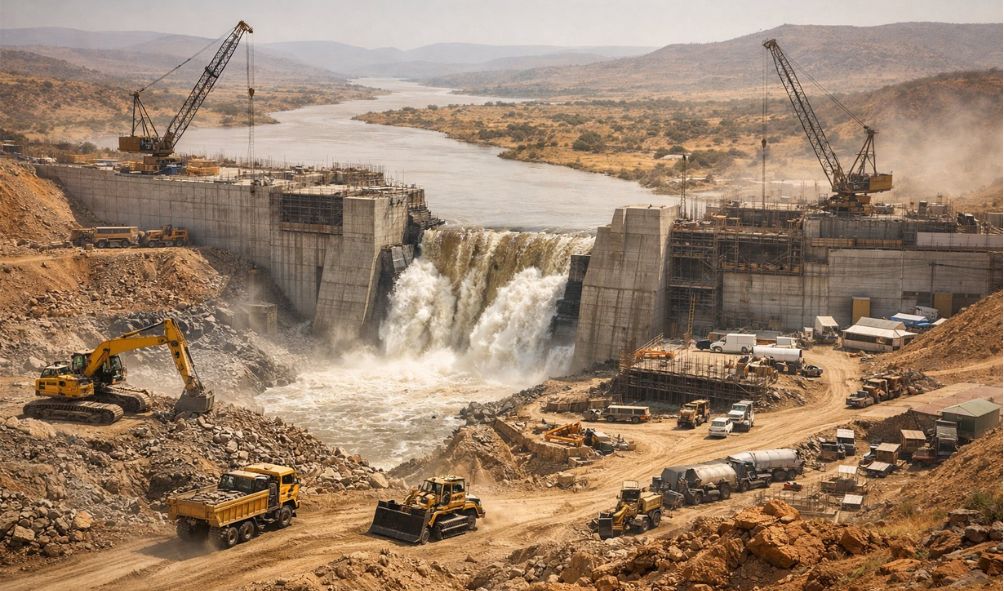
Kenya Set To Build Six New Mega Dams In 2026
As part of President William Ruto’s pledge to build 50 massive dams around the country, the government has announced intentions to start building six mega dams this year.
The action is intended to increase irrigation, improve the nation’s food security, and shield farmers from the escalating effects of climate change.
The Ministry of Water and Irrigation is leading these initiatives, which are anticipated to assist irrigation on roughly two million acres of land.
primarily the semi-arid and arid areas that have historically been underutilized because of erratic rainfall.
Projects for Turkana, Baringo, Embu, Isiolo, Kitui, Tharaka Nithi, Tana River, and Kilifi counties are among the six dams that are anticipated to begin construction early this year.
On Tuesday, January 27, Principal Secretary for Irrigation Ephantus Kimotho stated that the government’s long-term plan for climate resiliency and sustainable agricultural output depended heavily on irrigation expansion.
In 2026, the State Department for Irrigation is set to undertake the construction of six mega dams across the country as part of a transformative irrigation and water security programme.
— Ministry of Water, Sanitation and Irrigation (@MOWSI_KE) January 26, 2026
The projects include the Lowaat Dam in Turkana County, Radat Dam in Baringo County, Thuci Dam… pic.twitter.com/PFjb2CpmPH
“Whenever rains fail, it affects the farmers greatly, and those are some of the effects of climate change,” Kimotho said.
“Irrigation comes in as a mitigating factor. Whenever there is rain, we store water, and when there is drought, we use that water to do irrigation.”
Nearly two million acres have been set aside for irrigation projects nationally, primarily in regions that are frequently impacted by drought and prolonged dry weather, according to the chief secretary.
Kimotho emphasized that irrigation will now be viewed as the primary means of increasing the nation’s agricultural output rather than as a supplemental measure.
Irrigation Secretary for Programmes, Michael Thuita, also weighed into the matter, saying the government’s irrigation push was deliberately focused on arid regions, which he described as Kenya’s greatest untapped agricultural resource.
“We are geared towards increasing the area under irrigation by promoting large dams in ASAL areas such as Mandera and the wider North Eastern region,” Thuita said.
ALSO READ:
- Kenya’s David Munyua Heads Back To PDC World Darts Championship
- A Man Dies In Police Custody, Family Says Victim Had Mental Illness
- DP Kindiki Makes A Ksh39 Billion Projects’ Pledge To Meru, Slams Local Leaders
- FKF Issues Way Forward On Kenya Premier League’s New Season
- Court Rules On 8 Utumishi Girls Fire Suspects, Explains Reasons Behind
“This region has land, sunlight and labour, but lacks reliable water infrastructure.”
He noted that arid and semi-arid areas of Kenya account for between 80 and 89 per cent of the country’s land coverage, yet contribute a small share to national food production.
Thuita further revealed that recurrent droughts have also made these regions hotspots for food insecurity and humanitarian interventions, with millions of households requiring assistance during prolonged dry seasons.
President Ruto: In the next 7 years, we will build 28,000 km of roads, build 50 new mega dams, 200 medium-sized dams and thousands of small dams across the country, and another 10,000MW of energy. We have the money to do it. I know you don't believe me, but money is not the… pic.twitter.com/IR34pyhVW9
— KBC Channel 1 News (@KBCChannel1) January 23, 2026
Beyond food production, the Ministry officials noted that the dams and irrigation projects are expected to stimulate wider economic activity, including agro-processing, value addition and rural employment.
Kenya Set To Build Six New Mega Dams In 2026