Ruto Signs National Infrastructure Fund Bill Into Law
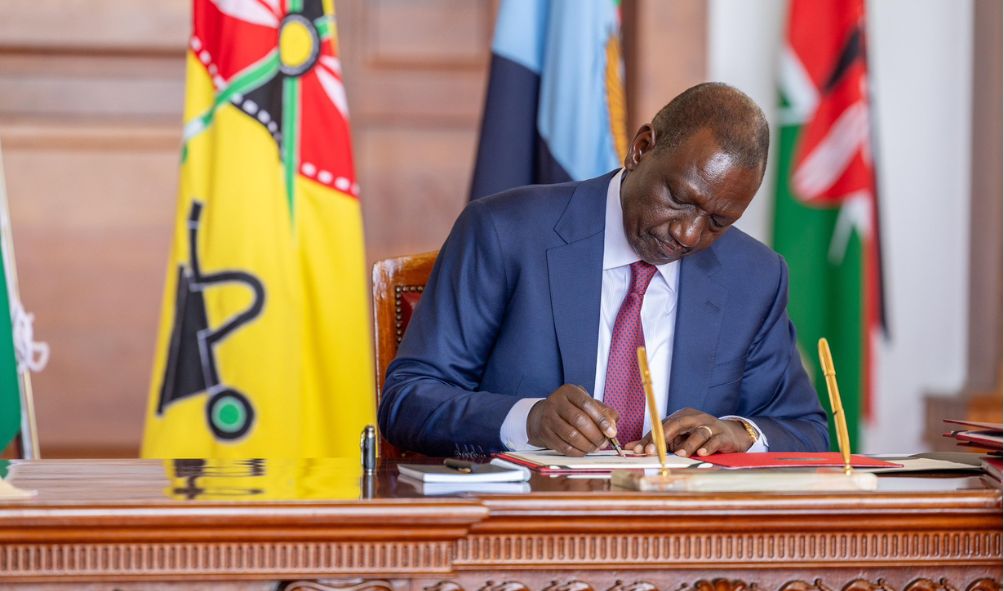
President William Ruto has assented to the National Infrastructure Fund (NIF) Bill.
The assent was done at the State House, Nairobi, on Monday, March 9.
This now formally establishes the national infrastructure fund designed to mobilise over KSh 5 trillion in the next 10 years for large-scale infrastructure development projects.
The assent by the head of state followed the bill’s passage by the National Assembly on March 5, after a third reading.
With the bill now law, it represents a shift in Kenya’s economic policy, moving away from a debt-driven financing model toward a sustainable investment-led approach.
Structured as a body corporate, the fund can own property, enter contracts, and invest in projects, but is barred from borrowing or taking credit against its balance sheet.
Ruto also revealed that it will be run by competitive individuals, casting doubt on politicians running it.
Speaking after the assent, the head of state said the fund will transform how Kenya finances major development projects.
He also announced that the government will raise Ksh 106 billion through the partial privatisation of the Kenya Pipeline Company, the funds that will serve as the basis for NIF.
The president also stated that government agencies will now operate under the fund, which will access capital markets to fund additional infrastructure projects.
“Government agencies like KAA, KPA, Kenya Railways, and NCPB, among others, will now operate under NIF,” Ruto stated.
“The entities will access capital markets over time, and the proceeds will be used to build more infrastructure for the future.”
During the event, Treasury Cabinet Secretary John Mbadi said the fund will be overseen by a seven-member Board of Directors, chaired by an independent director, with the Treasury CS also sitting on the board.
The board will report to the ministry four times every year.
“We have two levels of management for this fund,” Mbadi stated.
“The board will be reporting to cs for Treasury four times in a year, and the cs will report to the cabinet at least twice in a year. We will also be reporting to the national assembly at least once a year.”
The board will include four independent directors and two development banking experts.
It will also have strict rules barring members from recent government employment or political affiliations to safeguard independence.
ALSO READ:
- Kenya’s David Munyua Heads Back To PDC World Darts Championship
- A Man Dies In Police Custody, Family Says Victim Had Mental Illness
- DP Kindiki Makes A Ksh39 Billion Projects’ Pledge To Meru, Slams Local Leaders
- FKF Issues Way Forward On Kenya Premier League’s New Season
- Court Rules On 8 Utumishi Girls Fire Suspects, Explains Reasons Behind
The directors cannot have conflicts of interest tied to suppliers, consultants, or auditors linked to the National Infrastructure Fund.
They will serve three-year terms, which can be renewed only once.
Grounds for removal from the board include bankruptcy, conviction, absenteeism, and entry into political office.
All these guardrails are meant to enhance integrity and stability
President Ruto had earlier disclosed that Kenya expects to raise Ksh2.5 trillion, half of the total target, by April this year, with the remaining Ksh2.5 trillion to be raised in the course of 10 years as stipulated earlier.
Ruto Signs National Infrastructure Fund Bill Into Law