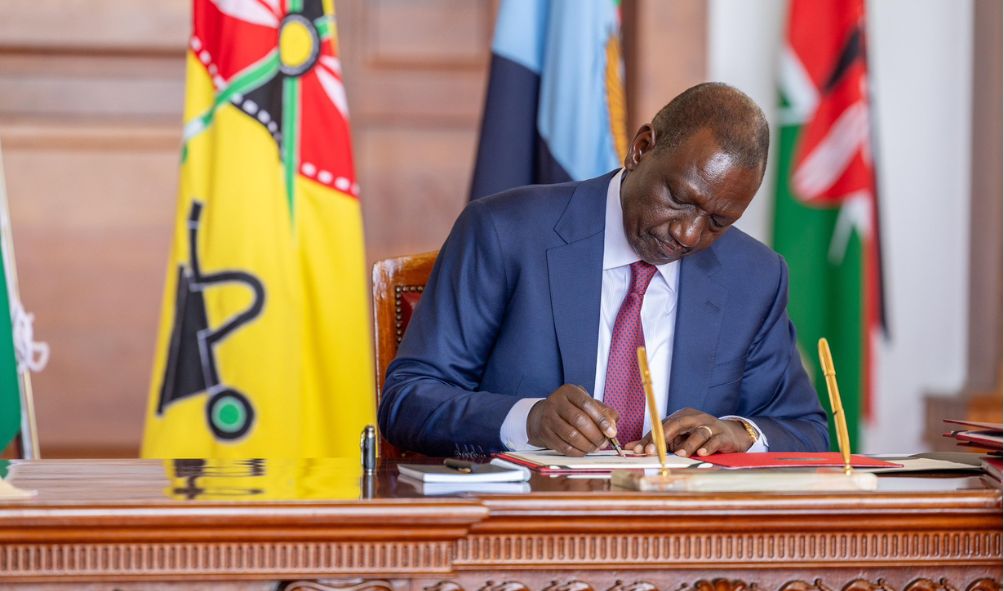
Ruto Signs New Sugar Law, Details How It Will Affect Kenyans
Today, Friday, November 1, President Ruto signed the Sugar Bill into law, which will regulate and structure Kenya’s sugar industry.
The primary goal of the Bill is to provide for the development, regulation, and promotion of the sugar industry following the repeal of the previous Sugar Act by the Crops Act in 2013.
One of the key aspects of the new law is the regulation of sugar prices, which could provide relief for the critical commodity.
The Sugar Bill (National Assembly Bills No. 34 of 2022) was published on October 6, 2022, through Kenya Gazette Supplement No. 150 of 2022, and was read for the first time on November 9, 2022.
President Ruto assents to Sugar Bill aimed at revitalising the sugar sector pic.twitter.com/LIQyNlZiqk
— NTV Kenya (@ntvkenya) November 1, 2024
Emmanuel Wangwe, MP, is the Member of Parliament for Navakholo, and Senator David Wakoli co-sponsored the Bill in the Senate.
The new law provides for the re-establishment of the Kenya Sugar Board (KSB), whose functions are currently carried out by the Agricultural Food Authority’s Sugar Directorate.
The Kenya Sugar Board will be responsible for regulating, developing, and promoting the sugar industry, as well as coordinating stakeholders, participating in policymaking, and collaborating with the government and research institutions.
The Board will also oversee the sugar trade, advise growers, set pricing, license mills, and monitor the market.
The Board will consist of 14 members, including a non-executive chairperson, five representatives elected by growers in the counties clustered under the Central, Upper Western, Lower Western, Southern and Coastal sugar catchment areas.
The enactment of the Sugar Bill sets the right pace for the stimulation of our sugar sector and will address deep-rooted challenges that have for long crippled the once vibrant and profitable industry.
— William Samoei Ruto, PhD (@WilliamsRuto) November 1, 2024
Particularly, it facilitates the re-establishment of the Kenya Sugar Board,… pic.twitter.com/PyVyZmAMmD
Others include two representatives from private and public sugar mills, the Principal Secretary for Agriculture, a representative from the Council of County Governors, the Principal Secretary for National Treasury, and a Chief Executive Officer.
The Board will serve for a three-year term, which is renewable once. Furthermore, the Board will be responsible for appointing qualified crop inspectors to conduct inspections and enforce sector-specific laws.
The new law enhances and structures funding for the Board’s work. The Board’s funds include monies appropriated by the National Assembly for its purposes, as well as the Sugar Development Levy.
It is intended to be levied on domestic sugar and held in a Sugar Development Fund that is administered by the Board.
The Levy is set at 4% of the value of domestic sugar and 4% of the Cost Insurance Freight (CIF) value of imported sugar.
The allocations include 15% for factory development, 15% for research, 40% for cane productivity, 15% for infrastructure in sugarcane-producing regions, 10% for Board administration, and 5% for sugarcane farmer organizations.
The bill also establishes the Kenya Sugar Research and Training Institute (KSRTI). The Institute’s mandate includes, among other things, promoting, coordinating, and regulating research in sugar, sugar crops, sugar byproducts, sugar technologies, and management practices.
ALSO READ:
- Kenya’s David Munyua Heads Back To PDC World Darts Championship
- A Man Dies In Police Custody, Family Says Victim Had Mental Illness
- DP Kindiki Makes A Ksh39 Billion Projects’ Pledge To Meru, Slams Local Leaders
- FKF Issues Way Forward On Kenya Premier League’s New Season
- Court Rules On 8 Utumishi Girls Fire Suspects, Explains Reasons Behind
Furthermore, it facilitates equitable access to research information, resources, sugar technologies, and innovations, as well as the application of research findings in the development of the sugar industry.
The Institute will be managed by a nine-member Board that includes a chairperson appointed by the Cabinet Secretary, a representative of the apex body of sugarcane growers, and a representative of the sugarcane manufacturers.
The Council of Governors also appoints one representative, one nominated by the Cabinet Secretary, the Principal Secretary for the National Treasury, the Principal Secretary for Agriculture, the Director General of the Kenya Agricultural Livestock and Research Organization, and a Managing Director.
The recently passed Bill aims to strengthen the industry by increasing production, improving milling efficiency, aligning capacity with cane supply, promoting value addition, and providing critical funding to all stakeholders.
Ruto Signs New Sugar Law, Details How It Will Affect Kenyans