Gov’t Hits Back At The Economist For Scathing Column Against Ruto
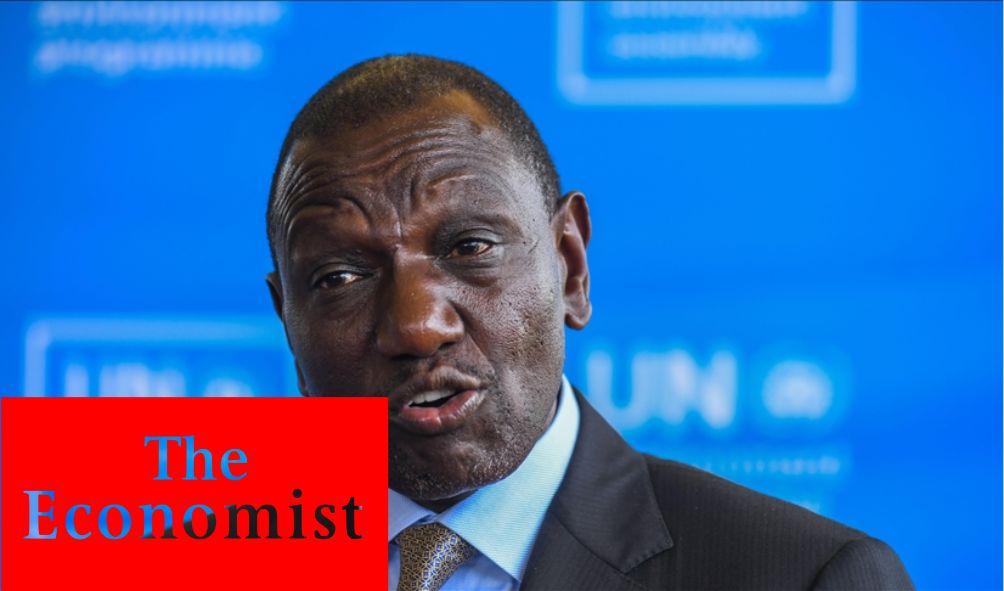
The Kenyan government has replied to The Economist’s harsh editorial criticising President William Ruto’s policies and what it describes as increasingly authoritarian rule.
The piece, titled ‘William Ruto is bringing Kenya to a perilous place’, accused Ruto of breaking his electoral promises to improve the lives of ordinary Kenyans.
According to the column, he instead responded to public protests with brutality and suppression.
The editorial, published on July 3, made reference to the June 25 protests, which resulted in the loss of life.
Kenya once set a fine example to the rest of Africa. The country now offers a how-to guide on smothering dissent. It could get worse https://t.co/f3TPWYRl5s
— The Economist (@TheEconomist) July 6, 2025
Furthermore, it resulted in the temporary closure of global corporations operating in Kenya, highlighting corruption as a prominent feature of Ruto’s difficult administration.
As a result, the journal stated that President Ruto should not run for reelection in the 2027 general election, saying that another term will lead the country down a perilous path.
The media outlet went on to say that Ruto’s image was ‘tainted’ and that his ruined reputation left little chance for further improvements.
However, in a statement issued later by The Economist, State House Spokesperson Hussein Mohamed questioned the media house’s legitimacy in discussing Kenya’s elections and Ruto’s choice to run for re-election.
The Kenyan government responds to our leader on President Ruto https://t.co/ltwQbAW8kb
— Hussein Mohamed, MBS. (@HusseinMohamedg) July 18, 2025
“What do you mean by saying President Ruto’s image is ‘tainted’ and he should not seek re-election? Shouldn’t the voters, not The Economist, make that decision at the next election?” Mohamed posited.
Mohamed defended President Ruto’s government, arguing that rather than driving the country into decline, the President was making difficult decisions and “reshaping Kenya’s future through bold, necessary reforms.”
He cited key indicators of progress, including Kenya’s economic growth, a significant drop in inflation, a stronger shilling, and the gradual easing of the Central Bank Rate (CBR).
Right of Reply to The Economist:
— Hussein Mohamed, MBS. (@HusseinMohamedg) July 18, 2025
William Ruto is Making the Hard Choices Others Feared, and Reshaping Kenya
This is the full version of the text submitted to The Economist on 9th July 2025, prior to their editorial changes.
The edited text as published by The Economist with… pic.twitter.com/Rtk96jN5O8
Hussein insists that all those were fostering economic empowerment among Kenyans.
“Since August 2022, Kenya has recorded an average annual GDP growth rate of five per cent, outperforming the global average of 3.3 per cent and the regional average of 3.8 per cent,” Mohamed stated.
“Inflation, which stood at 9.6 per cent in October 2022, fell sharply to 3.8 per cent by May 2025, well below the Central Bank of Kenya’s five per cent target, bringing relief to millions of households.”
Addressing concerns over multinational companies exiting or scaling down their operations in Kenya, Mohamed revealed that several global firms had recently announced plans to open their African offices in Nairobi.
These include BUPA Global, Africa Speciality Risk, Lloyd’s, and the European Bank for Reconstruction and Development.
On the sensitive issue of protests, Mohamed acknowledged previous demonstrations and stated that the freedom to picket is guaranteed by the Constitution.
ALSO READ:
- Kenya’s David Munyua Heads Back To PDC World Darts Championship
- A Man Dies In Police Custody, Family Says Victim Had Mental Illness
- DP Kindiki Makes A Ksh39 Billion Projects’ Pledge To Meru, Slams Local Leaders
- FKF Issues Way Forward On Kenya Premier League’s New Season
- Court Rules On 8 Utumishi Girls Fire Suspects, Explains Reasons Behind
However, he highlighted that some rallies had become violent, resulting in property destruction and attacks on police stations.
“The right to protest must not infringe on the rights of others. In any functioning democracy, that is always a difficult balance to strike,” he said.
Ruto, on his part, announced that he will run for re-election, claiming that his report card was sufficient evidence of his efforts to achieve a second term.
He has also remained optimistic about the chances of his challengers, including his former Deputy Rigathi Gachagua.
Ruto insisted that they have nothing to show Kenyans about why they should be chosen.
Gov’t Hits Back At The Economist For Scathing Column Against Ruto