CYRUS JIRONGO: How YK’92 Henchmen Rebranded, Redefined Kenyan Politics
As Kenya mourns the passing of Cyrus Jirongo, attention is once again drawn to the contentious Youth for KANU ’92 (YK’92) political group, which he led.
The former Lugari MP and cabinet minister was killed in an accident early Saturday morning, December 13.
Former Cabinet Minister and ex-Lugari MP Cyrus Jirongo has died following a fatal road accident, reports indicate.
— Mike Sonko (@MikeSonko) December 13, 2025
The former KANU stalwart, 64, is said to have died on the spot after his vehicle collided with a 45-seater passenger bus along the Nairobi–Nakuru highway at around… pic.twitter.com/lZdvfQleJ9
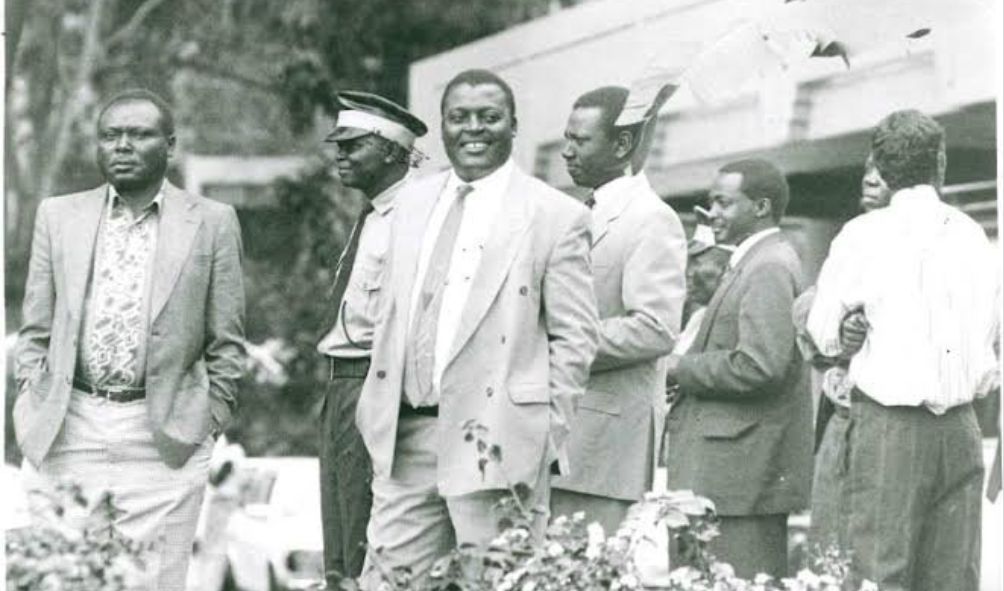
The YK’92, founded in the early 1990s, was a formidable political pressure group that helped President Daniel Arap Moi maintain power while Kenya transitioned from a one-party state to a multiparty democracy.
YK’92, founded ahead of the 1992 general election, became the ruling party’s most aggressive campaign organization, combining young mobilization, money, patronage, and intimidation to influence political outcomes.
During a period of political uncertainty, the group promoted itself as a youthful, vibrant movement defending KANU and ‘peace’.
However, YK’92 operated as a parallel political entity independent of traditional party channels. It was well-funded, extremely visible, and closely associated with President Moi.
Sometimes back when Cyrus Jirongo was reflecting on YK-92 and how elements wielding power to date could murder him if he published a book about that history.
— THEE ALFA HOUSE (@thee_alfa_house) December 13, 2025
"I wrote a book along time ago but I can't even release it because some people might just murder me. Let me tell you… pic.twitter.com/JYR0vfsNij
Its leaders were young, ambitious politicians and businesspeople like Jirongo (the national chairman), Sam Nyamweya, Gerald Bomett, Joe Kimhung, and William Ruto, who would eventually dominate Kenyan politics.
The defining characteristic of YK’92 was money. The group openly distributed cash to voters at rallies, gave them gifts, and paid for transportation, funding grassroots mobilization on a massive scale.
The Kenyan Ksh 500 banknote introduced in 1988, was nicknamed “Jirongo” in the early 1990s because it was widely distributed by Cyrus Jirongo’s YK’92 group as campaign handouts during the 1992 general elections.#ripjirongo pic.twitter.com/jYoQOp3mKO
— tonny sanya (@TonnySanya) December 13, 2025
Slogans, branded apparel, music, and large-scale rallies were their tools.
This strategy helped Moi win the fragmented 1992 election against a divided opposition led by figures such as Jaramogi Oginga Odinga, Kenneth Matiba, and Mwai Kibaki.
Beyond the campaign theatrics, however, YK’92 is also remembered for its darker role.
It was widely accused of stoking ethnic tensions, sponsoring violence and using intimidation to suppress opposition strongholds, particularly in the Rift Valley.
Though never formally prosecuted as an organization, its activities became central to debates on state-sponsored violence and electoral malpractice in Kenya’s early multiparty era.
YK’92 and Elections in Kenya. Politically, the 1992 elections reshaped Kenya in three lasting ways.
They professionalised and monetised electoral politics, normalising money as a decisive campaign tool. It also served as a springboard for a new political elite.
Many of its members later reinvented themselves as reformists, cabinet ministers, party leaders and even presidents, taking with them the networks and tactics forged in YK’92.
ALSO READ:
- United Opposition Chiefs Sign Unity Pact, Gachagua Represented By Malala
- “Riggy G Is King!” – Gachagua Declares Defending Move For Presidential Seat
- Alarm As Another Kenyan Truck Driver Attacked, Killed In South Sudan
- Governor Sakaja Clarifies New Charges Targeting Creators, Film Makers
- HELB Introduces New Education Loans For Civil Servants Of Up To Ksh500,000
Finally, it entrenched a culture in which informal power structures could rival formal party institutions.
Following Moi’s re-election, YK’92 was abruptly disbanded in 1993 and officially declared unnecessary.
Critics argue that it had outlived its usefulness once its mission was achieved. Yet its legacy endured.
YK’92 remains a symbol of the contradictions of Kenya’s democratic transition: youthful energy was used not to deepen democracy, but to manipulate it.
This has left an imprint that still shapes political competition, mobilisation and power in Kenya today.
CYRUS JIRONGO: How YK’92 Henchmen Rebranded, Redefined Kenyan Politics