Kenya Announces Blockade of External Agricultural Project Donors
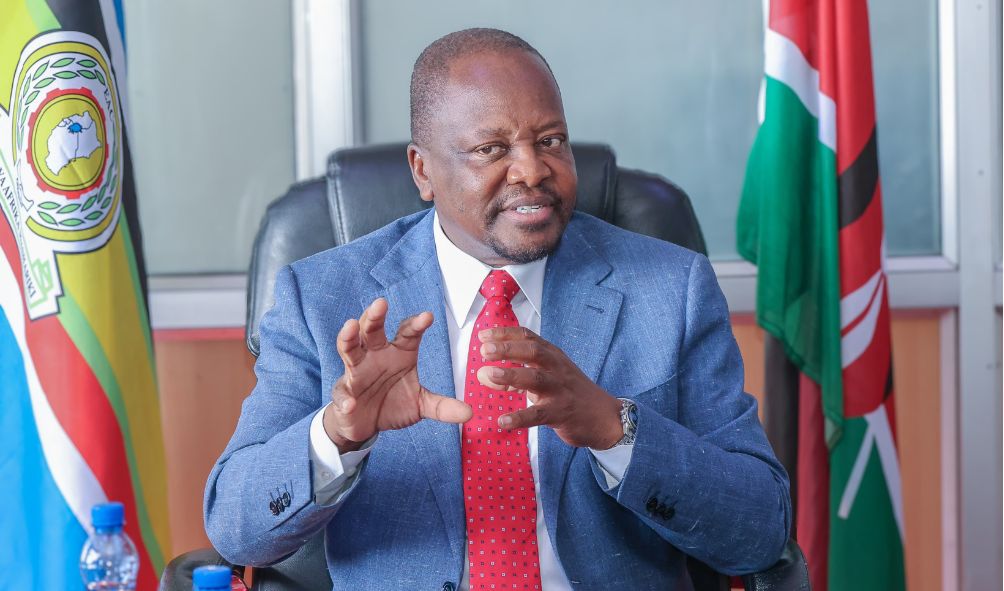
Mutahi Kagwe, the Agriculture and Livestock Cabinet Secretary, has announced that Kenya will no longer accept internationally developed projects that do not represent local reality.
Kagwe advised donors against imposing generic, homogenous, externally designed initiatives on Kenya, indicating a more assertive approach in the country’s dealings with development partners.
On Tuesday, February 3, the CS spoke at a consultative meeting between the National and County Governments and the World Bank in Mombasa.
Kagwe advocated that Kenya take the initiative in defining and co-designing schemes to revitalize its agricultural industry.
He also stated that Kenya will not accept being treated like other countries, claiming that the republic is not the same as other countries and has unique needs.
“Do not tell us you are funding us because you are funding 20 other countries. We are not the same,” the CS stated.
“Our needs are different. We want to be initiators. We want to be co-designers. We will reject projects that we have not tailored.”
KENYA WILL REJECT UNTAILORED PROJECTS.
— Cabinet Secretary Agriculture & Livestock Dev't (@CS_MoALD) February 3, 2026
CS Sen. Mutahi Kagwe has warned development partners against imposing generic agricultural projects on Kenya, saying the country will reject initiatives not locally designed or aligned to its needs. pic.twitter.com/Xd0LXR2JHQ
He also asked that Kenya’s agricultural priorities be properly structured and matched with national and local development plans, noting that badly conceived initiatives reduce impact and responsibility.
He urged county governments to ensure that their agriculture projects are well-structured and linked to national digital platforms.
To eliminate duplication and increase coordination, this comprises the Kenya Integrated Agriculture Management Information System (KIAMIS) and the Kenya Agricultural Digital Information Centre (KADIC).
“Leverage on convergence. Avoid duplication. Plug into national systems,” the CS urged.
Many donor-funded programs in Africa have historically employed the same model and techniques throughout countries, without taking into consideration the fact that certain countries outperformed others in certain projects.
The warning by Kagwe now signals that donor-funded projects in Kenya will have to account for its diverse ecological zones, from fertile lands to arid lands.
This will see a higher rate of success as the cs notes that when a project is designed for specific soil, climate and culture, it is likely to succeed even after donor funding dries up.
During the same meeting, Kagwe also reminded stakeholders that ongoing World Bank–funded programmes, including the National Agricultural Value Chain Development Project (NAVCDP) and the Food Systems Resilience Project (FSRP), are financed through loans amounting to KSh 49.5 billion, and must therefore deliver value for money.
ALSO READ:
- Kenya’s David Munyua Heads Back To PDC World Darts Championship
- A Man Dies In Police Custody, Family Says Victim Had Mental Illness
- DP Kindiki Makes A Ksh39 Billion Projects’ Pledge To Meru, Slams Local Leaders
- FKF Issues Way Forward On Kenya Premier League’s New Season
- Court Rules On 8 Utumishi Girls Fire Suspects, Explains Reasons Behind
“These are not ordinary projects. Their success or failure has consequences for food security and national stability,” he said.
He also revealed that the government is prioritising large-scale production of key crops.
This includes maize, rice, wheat, sorghum and palm oil through public-private partnerships and the Land Commercialisation Initiative in efforts to reduce dependence on imports.
He raised a major concern about food imports, noting that Kenya spends over Ksh500 billion annually on them. He said this was unsustainable and a threat to food sovereignty.
Kenya Announces Blockade of External Agricultural Project Donors