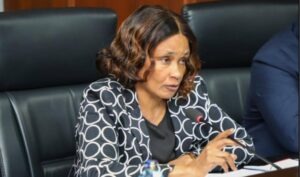
State Department for Basic Education PS Prof. Julius Bitok with Ministry of Education Deputy Accountant General Emilio Mukira before Public Accounts Committee (PAC) to respond on the financial accounts and the Auditor General’s report for the financial year ended 30th June 2023 at Parlaiment Building on June 10,2025.PHOTO/ENOS TECHE
Gov’t Admits To Extreme Underfunding Of Kenya’s Basic Education
The Ministry of Education has admitted that it has been disbursing less money to fund free education with more than 1.1 million secondary school students not receiving capitation cash.
Basic Education Principal Secretary Julius Bitok says budget requirements and disbursements to schools established that the amount disbursed to schools and programmes was less than the amounts set in the policy documents.
Despite the state setting Sh22,044 per student, the ministry has only been disbursing an average Sh15,844.38 per student leaving schools with a huge deficit.
The PS said although the number of student enrolment has been growing exponentially over the years, the budgetary allocation remains the same leading to underfunding.
The underfunding amounted to Sh71,022,126,504 for secondary schools, Sh31,981,877,799 for Junior Secondary Sh14,048,116,230 for primary schools and Sh67,117,182 for secondary schools SNE between financial years 2020/21 to 2023/24.
“It is true that the budgetary allocations for secondary schools fall short of the submitted requirements during the years under review for schools,” Prof Bitok told MPs on Wednesday morning.
At secondary school level, the PS said budgetary and enrolment data across fiscal years 2020/2021 to 2023/2024 indicates underfunding of Sh76,995,346,067.
The approved rate remained constant at 22,244, while enrolment increased from 3,396,322 in 2020/2021 to 4,036,650 students in 2023/24 meaning the requirement based on enrolment grew significantly, from about Sh75.5 billion to nearly Sh89.8 billion.
The government has disbursed Sh23.4 billion in capitation funds for the second term, Basic Education PS Julius Bitok has confirmed. The funds are expected to reach school accounts by Friday, ensuring public schools are ready to reopen next week. pic.twitter.com/Idm6bVsnXJ
— The Eastleigh Voice (@Eastleighvoice) April 22, 2026
“Despite this, the approved budget increased only marginally, resulting in a growing deficit that reached more than Sh25.8 billion by 2023-24,” he said.
“The number of learners not provided for increased from 724,959 to 1,161,349, and the amount paid per learner shows a decline from Sh17,495.95 to Sh15,844.38.”
The budgetary allocations for junior schools also fell short of the submitted requirements during the years under review for schools with budgetary and enrolment data across fiscal years 2022-23 to 2023-24 indicating underfunding of Sh3,624,222,370.
The approved rate remained constant at Sh15,043, while enrolment increased from 1,021,059 in 2022-23 to 2,170,429 in 2023-24.
“The gap between policy and actual disbursement is primarily a function of fiscal constraints and increased enrolment pressures,” the PS said.
“However, the state department has ensured that the available resources are distributed transparently, equitably, and strictly to verified learners.”
ALSO READ:
- Kenya’s David Munyua Heads Back To PDC World Darts Championship
- A Man Dies In Police Custody, Family Says Victim Had Mental Illness
- DP Kindiki Makes A Ksh39 Billion Projects’ Pledge To Meru, Slams Local Leaders
- FKF Issues Way Forward On Kenya Premier League’s New Season
- Court Rules On 8 Utumishi Girls Fire Suspects, Explains Reasons Behind
Prof Bitok told MPs that a Special Audit concluded that the current allocation per learner, based on the funding model, does not factor in the varying needs and circumstances of the learners and Schools; “The capitation model therefore is not equitable.”
The report showed that the capitation per student was based on the number of students enrolled in National Education Management Information System (Nemis).
However, there were instances where the number of students enrolled in Nemis differed with the actual enrolment as per the respective school registers.
“The state department concurs that there are variances between actual number of students enrolled and those registered in Nemis,” he said.
“The reasons for this are delayed data entry by schools, Network/poor connectivity in rural areas, Inadequate training/capacity gaps, Learner mobility due to transfers or absenteeism, Unregistered learners due to lack of birth certificates. Measures have been instituted to transit from Nemis to Kemis.”
Gov’t Admits To Extreme Underfunding Of Kenya’s Basic Education