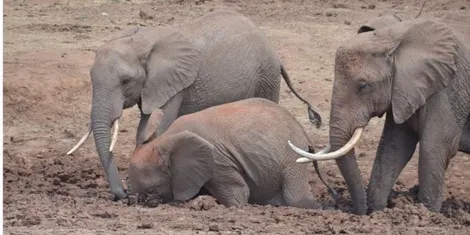
KWS Issues Statement After Death of 13 Elephants In Amboseli, Reveals Cause
An urgent investigation has been launched into the mysterious deaths of 14 elephants in southern Kenya near the Amboseli National Park.
The Kenya Wildlife Service (KWS) told the BBC that experts were examining the carcasses and said that tissue samples had been sent to laboratories to determine whether the deaths were caused by disease, poisoning or another factor.
The park and its surrounds are known as the Amboseli ecosystem, a vast area that straddles the border with Tanzania, which is famous for its wildlife.
Officials say this is the first time in decades that elephant mortalities on this scale have been recorded in the region where they have successfully cracked down on poaching.
KWS says there is currently no evidence pointing to a single cause of death.
“Between 24th June and 24th July 2026, 15 elephant deaths were recorded in Amboseli National Park, Kimana Sanctuary and the Kuku Ranch area,” KWS stated.
“Of these, 10 elephants exhibited similar clinical signs, including partial paralysis that left them unable to stand before dying within one to two days.”
ALSO READ:
- Kenya’s David Munyua Heads Back To PDC World Darts Championship
- A Man Dies In Police Custody, Family Says Victim Had Mental Illness
- DP Kindiki Makes A Ksh39 Billion Projects’ Pledge To Meru, Slams Local Leaders
- FKF Issues Way Forward On Kenya Premier League’s New Season
- Court Rules On 8 Utumishi Girls Fire Suspects, Explains Reasons Behind
The carcasses include elephants of different ages and sexes, suggesting the deaths are not limited to a single family or demographic.
The wildlife agency’s head of communication, Duncan Wanyama, told local media the bodies had been found at different locations surrounding the Amboseli National Park, around 15km (nine miles) to 30km from its boundaries.
According to figures from the Amboseli Trust for Elephants, which monitors the movements of the animals, there were more than 2,000 elephants in the Amboseli ecosystem as of 2025.
KWS said environmental investigations were also underway, including analysis of water sources and other potential environmental contaminants within the affected areas.
At the same time, it has intensified surveillance across the Amboseli Ecosystem and is closely monitoring elephant populations as investigations continue.
KWS Issues Statement After Death of 13 Elephants In Amboseli, Reveals Cause