US-Kenya Trade Deal Could Collapse Despite Pres Ruto’s Visit
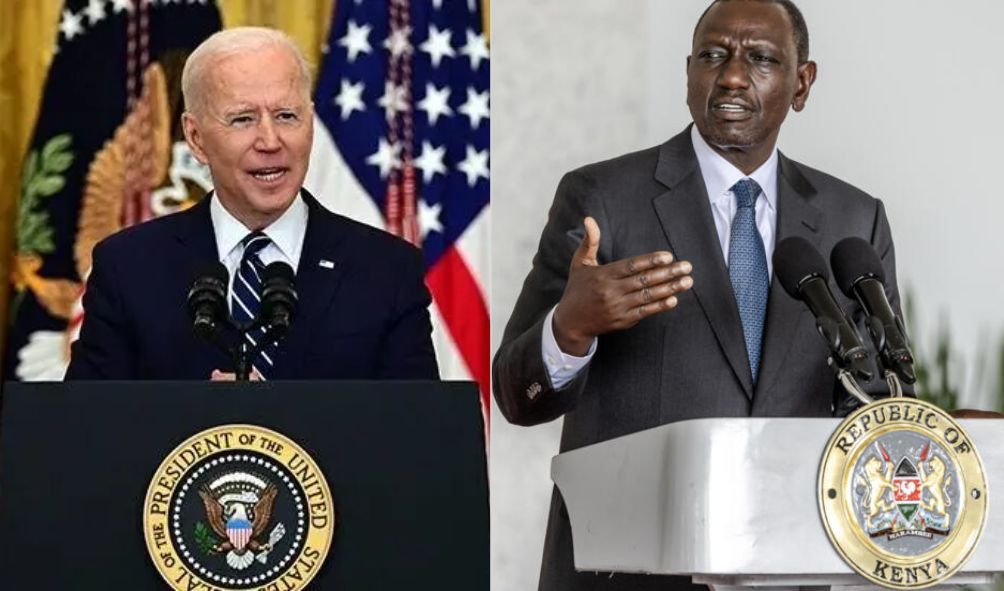
During his week-long State visit, President William Ruto and his colleague from the United States, Joe Biden, are anticipated to have comprehensive discussions about trade and investment.
According to a comprehensive itinerary of Ruto’s visit released by State House Spokesperson Hussein Mohamed on Sunday, President Ruto and Biden will hold bilateral meetings on Thursday, with the focus mostly on trade and potential avenues of opportunity for the two nations.
However, a report published by the US Congressional Research Service voiced worries about a number of issues that could influence how fruitful the negotiations ultimately become.
Currently, the African Growth and Opportunity Act (AGOA) promotes trade links between Kenya and the US.
AGOA is a piece of legislation adopted by the US Congress in May 2000 that aims to strengthen economic cooperation between Sub-Saharan African countries and the United States.
According to data from the Office of the US Trade Representative, Kenya is the fourth greatest recipient of the AGOA Act, having contributed goods worth USD614 million (Ksh80.5 billion) between 2001 and 2022.
During former US President Donald Trump’s presidency, Kenya and the US sought to reach a Free-Trade Agreement, but the talks fell through.
The Biden administration has worked hard to succeed where Trump’s administration failed by launching the Kenya Strategic Trade and Investment Partnership (STIP) in July 2022.
Following the start of the STIP talks, the countries have had at least three rounds of discussions, which are scheduled to continue during President Ruto’s visit to the White House.
According to a US Congressional Research Service assessment, the US government may seek to negotiate commitments similar to those in comprehensive free trade agreements with comparably more developed countries, which could harm Kenya due to its lower-middle-income position.
This might also pose difficulties for the Kenyan government, which is under public pressure to preserve safeguards for import-sensitive and indigenous businesses.
Furthermore, Kenya vigorously defends vital economic sectors, especially agriculture, through various legislation. The US has repeatedly highlighted this as a potential trade obstacle.
Previous examples include rather high tariffs on dairy (53.1%), animal products (30%), and cereals (28.1%).
The US has also identified Kenya’s customs procedures as inefficient, potentially impeding trade.
Another point of worry for the Biden administration is that the US government has previously described Kenya’s 2019 Data Protection Act as unclear, creating uncertainty for cross-border data flows.
US-Kenya Trade Deal Could Collapse Despite Pres Ruto’s Visit





![[VIDEO] Delapidated State Of Ksh 3.9 billion Ngong-Suswa Road A Year After Commission](https://africasnow.com/wp-content/uploads/2026/07/Nairobi-2026-07-07T210620.569-300x177.jpg)