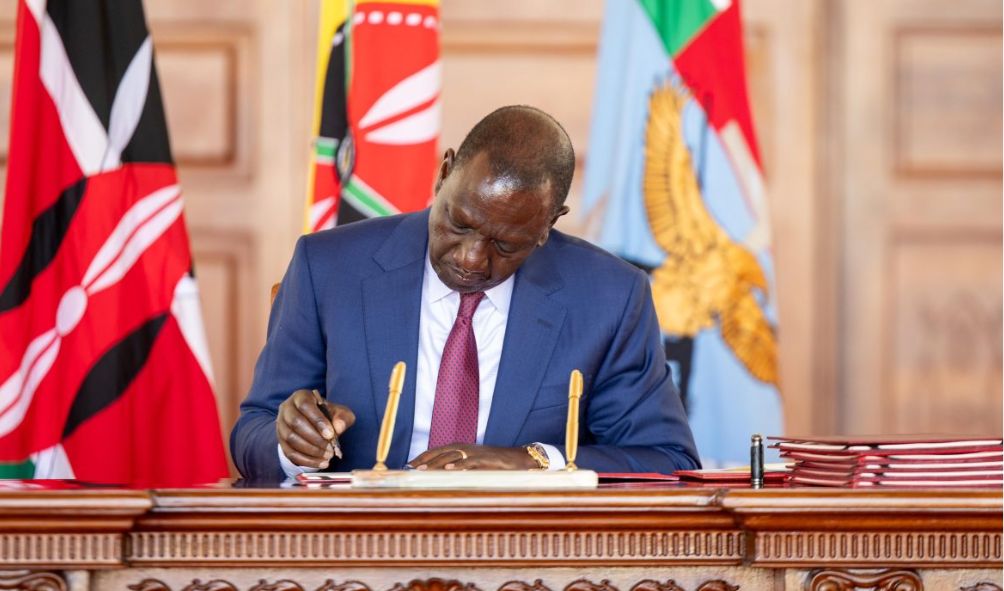
Ruto Appoints New Ambassadors, Deputy Envoys
President William Ruto has announced additional Foreign Service appointments, including new envoys to key posts abroad.
“The president has instituted further changes within the nation’s Foreign Service, whose diplomatic footprint now extends to seventy-two countries/territories,” read a press release from the Executive Office of the President.
According to the statement, the changes are part of continuous efforts to improve diplomatic representation.
“These changes comprise nominations for appointments to newly established missions as sanctioned by Cabinet, and the filling of vacancies arising from the end of tenure of serving diplomats.”
Kosiom Frank Ole Kibelekenya has been nominated as Ambassador to Copenhagen, Denmark.
Elias Bare Shill has been appointed as Deputy Ambassador to Mogadishu, Federal Republic of Somalia.
Elias Bare deputizes Ambassador Kubai Iringo, who is the current Ambassador of the Republic of Kenya to the Federal Republic of Somalia.
Amb Iring presented his credentials to Somali authorities in early 2024 and continues his tenure into 2025-2026.
Amb Joseph Warui has been sent to Moscow, the Russian Federation, while Amb. Mohammed Hussein Nur has been assigned to Dar es Salaam, United Republic of Tanzania.
H.E President @WilliamsRuto has instituted additional diplomatic appointments in the foreign service as captured in the Press release. pic.twitter.com/qwOm9xc6rn
— felix koskei (@koske_felix) February 6, 2026
The President has also made one nomination to Parliament.
“His Excellency the president has transmitted the nomination of the full Ambassador to the National Assembly for consideration and approval by Parliament.”
Felix Koskei, the Chief of Staff and Head of Public Service, signed the notice.
These are fresh appointments that had no sitting envoys from Kenya. According to the Ministry of Foreign Affairs
Process of Creating a New Embassy
Creating an embassy where none existed requires a process that has to be followed.
This process is governed by the Vienna Convention on Diplomatic Relations (1961), which governs embassy establishment through mutual consent between sending and receiving states.
ALSO READ:
- Kenya’s David Munyua Heads Back To PDC World Darts Championship
- A Man Dies In Police Custody, Family Says Victim Had Mental Illness
- DP Kindiki Makes A Ksh39 Billion Projects’ Pledge To Meru, Slams Local Leaders
- FKF Issues Way Forward On Kenya Premier League’s New Season
- Court Rules On 8 Utumishi Girls Fire Suspects, Explains Reasons Behind
Both countries must formally recognize each other’s sovereignty and negotiate through third-party channels or United Nations forums.
Article 2 requires receiving state approval for resident missions. Countries must agree on mission size, classification, scope of activities, including consular services, and obtain agrément for the proposed ambassador before appointment.
Embassies are located in capital cities with premises secured through the receiving state’s assistance.
Host countries must protect premises against intrusion and damage, recognizing their inviolability under VCDR. Local authorities cannot enter without consent from the sending state.
Ruto Appoints New Ambassadors, Deputy Envoys