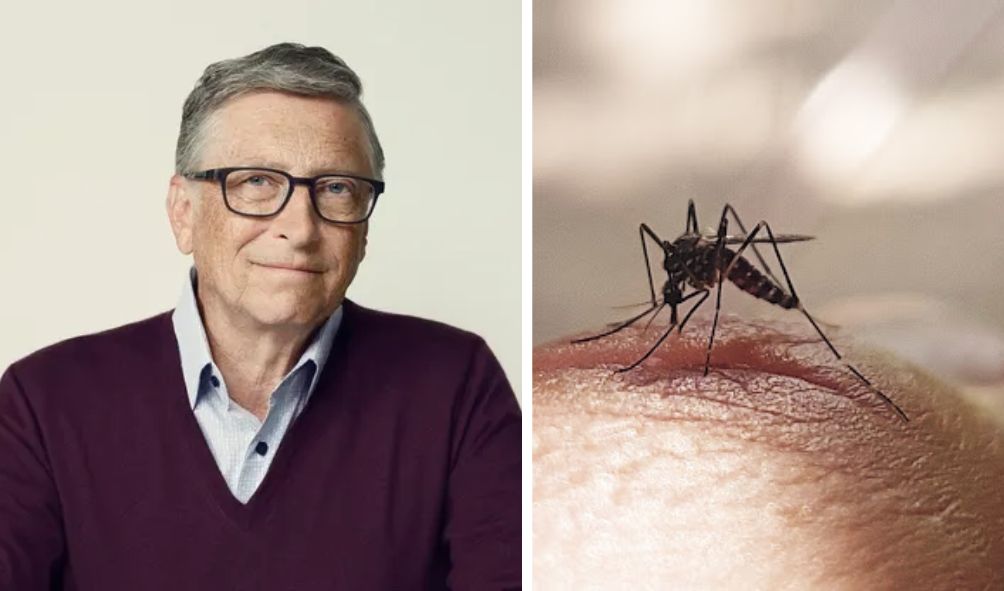
Gates Foundation Responds To Releasing ‘Modified Mosquitoes’ on Kenyans
The Gates Foundation has categorically disputed accusations on social media that its founder, millionaire and philanthropist Bill Gates, is responsible for Kenya’s significant increase in mosquito population.
The foundation characterized these assertions as “false” in a statement made to describe its involvement in the country’s public health sector.
It attempted to distance itself from rumours of illegal biological manipulations.
The clarification came after Kenyans online, led by Senior Counsel and politician Paul Muite, accused the foundation of nefarious mosquito-related operations.
@gatesfoundation:Our Capital City Nairobi is now flooded with mosquitoes released from your laboratories to eliminate the malaria-carrying ones we're told.We believe your genetically modified mosquitoes are designed to harm us. They're now busy biting children and the elderly
— Paul Muite SC (@Paul_Muite) February 9, 2026
The investigations also indicate that the foundation’s practices harmed children and the elderly.
He wrote: “@gatesfoundation: Our Capital City, Nairobi, is now flooded with mosquitoes released from your laboratories to eliminate the malaria-carrying ones we’re told.
“We believe your genetically modified mosquitoes are designed to harm us. They’re now busy biting children and the elderly.”
In a brief statement on X, the foundation stated that it is not involved in the physical release of insects or the direct operation of vector-control laboratories.
“The Gates Foundation is aware of social media posts claiming that we release mosquitoes in Kenya. This claim is false,” the foundation stated.
“The Gates Foundation does not release mosquitoes, operate laboratories that do so, or run vector-control activities in Nairobi or anywhere else.”
The Gates Foundation is aware of social media posts claiming that we release mosquitoes in Kenya. This claim is false.
— Gates Foundation Africa (@GatesAfrica) February 9, 2026
The Gates Foundation does not release mosquitoes, operate laboratories that do so, or run vector-control activities in Nairobi or anywhere else.
In Kenya,…
In response to concerns about regulatory supervision, the organization stated that all of its activities in Kenya complies with national regulations.
The organization stated that its purpose is to assist “Kenyan-led priorities” rather than dictating health policy or circumventing local government procedures.
“In Kenya, malaria prevention and control efforts are led by Kenyan authorities and institutions, in accordance with national laws and regulatory oversight,” they said.
“The foundation supports Kenyan-led priorities transparently and responsibly, working alongside governments, researchers, and public health partners.”
ALSO READ:
- Kenya’s David Munyua Heads Back To PDC World Darts Championship
- A Man Dies In Police Custody, Family Says Victim Had Mental Illness
- DP Kindiki Makes A Ksh39 Billion Projects’ Pledge To Meru, Slams Local Leaders
- FKF Issues Way Forward On Kenya Premier League’s New Season
- Court Rules On 8 Utumishi Girls Fire Suspects, Explains Reasons Behind
Muite’s remark elicited a wide range of responses from Kenyans, with several identifying instances in which they believe mosquitoes are mass-produced and discharged into the public.
The decision comes as malaria remains a major public health concern in the region.
Currently, the National Malaria Control Programme (NMCP), under the Kenyan Ministry of Health, oversees the distribution of long-lasting insecticidal nets (LLINs) and indoor residual spraying (IRS).
⚠️Bill Gates literally wants to turn mosquitoes into little vaccinators. You have to see this!!!!
— Bethany O’Leary 🇺🇸 🦅 (@BBMagaMom) February 8, 2026
Fair warning, it’s going to make you extremely angry. He wants to vaccinate all of us against our will via aerosol injection as well. I believe this means he wants to inject it… pic.twitter.com/jywCqqdqnV
While the Gates Foundation does fund global research into innovative tools, such as the World Mosquito Program or Target Malaria, it clarified that these specific operational activities in Kenya are managed by local experts and regulated by the state.
Gates Foundation Responds To Releasing ‘Modified Mosquitoes’ on Kenyans